Secure Software Development Lifecycle: The Complete Buyer’s Guide
When businesses choose a software development partner, they usually look at experience, pricing, technology expertise, delivery timelines, and past projects. But there is another factor that deserves just as much attention: security.
Security cannot be something that is checked only after an application is completed. By that stage, fixing vulnerabilities can be expensive, time-consuming, and sometimes disruptive to the entire project.
This is where a Secure Software Development Lifecycle (Secure SDLC) becomes important.
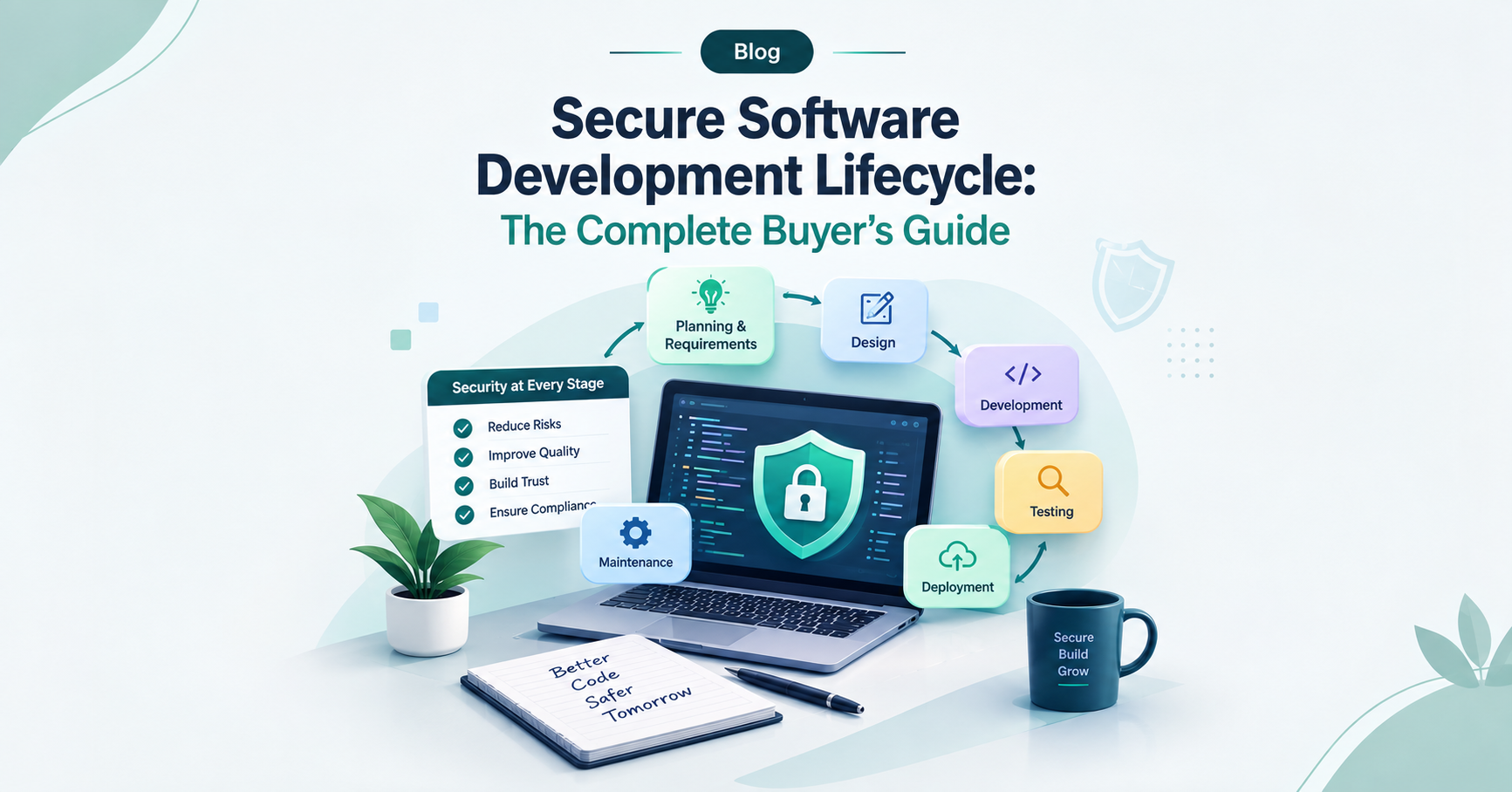
A Secure SDLC brings security into every stage of software development, from planning and design to development, testing, deployment, and maintenance. For buyers, understanding how a development partner handles security can make it easier to identify risks before they become costly problems.
This guide explains what Secure SDLC means, why it matters to software buyers, what activities should be included, and what questions you should ask before choosing a development partner.
What Is a Secure Software Development Lifecycle?
A Software Development Lifecycle (SDLC) is the process teams follow to plan, build, test, deploy, and maintain software.
A Secure SDLC adds security practices to each of these stages.
Instead of treating security as a final testing step, the development team considers it throughout the project.
For example:
During planning, security requirements are identified.
During design, potential threats are considered.
During development, secure coding practices are followed.
During testing, security vulnerabilities are checked.
During deployment, systems and configurations are reviewed.
After launch, applications are monitored and updated.
The goal is simple: find and reduce security risks as early as possible.
This approach is especially important for applications that handle customer information, payments, business data, authentication details, or other sensitive information.
Why Secure SDLC Matters to Software Buyers
When you hire a software development company, you are not only buying code. You are also trusting that company with your product, data, users, and sometimes your business reputation.
A security problem can affect all of these areas.
Imagine launching an application after months of development and discovering that a critical vulnerability allows unauthorized users to access customer information. Fixing that issue may require changes to the application architecture, database, authentication system, or deployment environment.
Security problems can also lead to:
Unexpected development costs
Delayed releases
Data exposure
Service interruptions
Loss of customer trust
Compliance challenges
Emergency maintenance
A Secure SDLC helps reduce these risks by making security part of the development process rather than an afterthought.
For buyers, this means security should be considered before signing a development contract, not only after the application is ready.
The Main Stages of a Secure SDLC
A Secure SDLC does not have to look exactly the same for every company. However, a reliable process generally includes security activities across the following stages.
1. Planning and Requirements
Security starts before developers write the first line of code.
During the planning stage, the development team should understand:
What type of data will the application handle?
Who will use the application?
What authentication is required?
Are payments involved?
What external services or APIs will be connected?
Are there regulatory or compliance requirements?
What business risks need to be considered?
Security requirements should be documented along with functional requirements.
For example, if an application contains customer accounts, requirements may include secure authentication, password protection, authorization, session management, and protection against unauthorized access.
As a buyer, ask your potential development partner how security requirements are identified and documented before development begins.
2. Secure Architecture and Design
Good security depends heavily on good architecture.
At this stage, developers and architects think about how different parts of the system communicate and where security controls should be applied.
One useful practice is threat modeling.
Threat modeling helps teams think about possible ways an application could be attacked and what controls can reduce those risks.
For example, a team may consider:
What happens if a user attempts to access another user's data?
What happens if an API request is modified?
What happens if an account is compromised?
What happens if an external service becomes unavailable?
Which parts of the system contain sensitive information?
The earlier these questions are considered, the easier it usually is to address them.
For buyers, this stage is important because architecture decisions can be expensive to change later.
3. Secure Coding
Developers turn the design into working software during the development stage.
This is where secure coding practices become important.
Developers should be trained to avoid common security mistakes and follow appropriate coding standards.
Some important practices include:
Validating user input
Protecting against injection attacks
Using secure authentication
Applying proper authorization
Protecting sensitive data
Managing secrets securely
Handling errors without exposing sensitive information
Keeping dependencies updated
Avoiding hardcoded passwords and API keys
Code reviews can also help identify security issues before code reaches production.
A buyer does not necessarily need to understand every coding technique, but should understand how the development partner verifies that developers are following secure practices.
4. Security Testing
Security testing should happen throughout development rather than only at the end.
Different testing methods can identify different types of problems.
For example:
Static Application Security Testing (SAST) examines source code for potential security weaknesses.
Software Composition Analysis (SCA) checks third-party libraries and dependencies for known vulnerabilities.
Dynamic Application Security Testing (DAST) tests a running application to identify security issues.
Penetration testing involves controlled attempts to identify and exploit vulnerabilities.
A mature development process may use several of these methods depending on the project's requirements.
The important question for buyers is not simply, "Do you perform security testing?"
Ask:
What type of security testing do you perform, when do you perform it, and how are findings handled?
That question gives you much more useful information about the partner's actual process.
5. Secure Deployment
Even a well-developed application can become vulnerable because of an insecure deployment environment.
Deployment security can involve:
Secure server configuration
Access control
Network security
Encryption
Environment management
Secrets management
Secure CI/CD pipelines
Logging and monitoring
Development and production environments should also be separated appropriately.
For example, developers should not automatically have unrestricted access to production systems.
As a buyer, it is worth asking who can access production systems, how access is controlled, and how deployment credentials are protected.
6. Monitoring and Maintenance
Security does not end when an application goes live.
New vulnerabilities are discovered regularly in operating systems, frameworks, libraries, cloud services, and other technologies.
A Secure SDLC therefore continues after deployment.
Ongoing activities may include:
Vulnerability monitoring
Dependency updates
Security patches
Log monitoring
Incident response
Periodic security testing
Access reviews
Backup verification
This is particularly important for long-term software projects.
When evaluating a development partner, ask what happens after launch. A partner should be able to explain how security issues are identified, prioritized, fixed, and communicated.
What Buyers Should Look for in a Development Partner
Not every company that claims to follow secure development practices has the same level of maturity.
Instead of accepting a simple "yes" when asking about security, look for evidence of a structured process.
Here are several areas to evaluate.
Security Process
Ask whether the company has a documented Secure SDLC process.
You can ask:
At which stages is security reviewed?
Who is responsible for security?
Are security requirements documented?
Are security checks part of the development workflow?
A documented process is easier to understand and evaluate than informal promises.
Developer Security Practices
Ask how developers are supported in writing secure code.
Questions can include:
Do developers receive security training?
Are code reviews performed?
Are automated security checks used?
How are security issues tracked?
These questions help you understand whether security is part of everyday development.
Testing Approach
Ask what security testing is included in the project.
Depending on the application, this could include automated scanning, dependency checks, penetration testing, API security testing, or other assessments.
Also ask what happens when a vulnerability is found.
A useful process should define how issues are recorded, prioritized, fixed, and retested.
Third-Party Dependencies
Modern applications often depend on open-source packages and external services.
These dependencies can introduce security risks if they contain known vulnerabilities or are no longer maintained.
Ask your development partner:
How are third-party dependencies tracked?
How are vulnerable packages identified?
How quickly are critical vulnerabilities addressed?
Who is responsible for dependency updates after launch?
This can be especially important for applications built using large JavaScript, Java, Python, or other package ecosystems.
Access and Data Protection
Your development partner may need access to source code, cloud infrastructure, databases, development environments, or other systems.
Make sure there is a clear access-control process.
Important areas include:
Role-based access
Multi-factor authentication
Least-privilege access
Secure credential management
Encryption
Production access controls
The goal is to make sure people have the access they need without giving unnecessary permissions.
Questions to Ask Before Hiring a Software Partner
Before selecting a development company, consider asking these practical questions:
Do you follow a documented Secure SDLC?
How do you identify security requirements during project planning?
Do you perform threat modeling or security architecture reviews?
How do you check code for security vulnerabilities?
What security testing is included in the development process?
How do you manage vulnerable third-party dependencies?
How are API keys, passwords, and other secrets stored?
Who can access production systems?
How are security vulnerabilities prioritized and fixed?
What security support is provided after deployment?
The answers can tell you much more about a company's security maturity than a general statement such as "security is our priority."
Common Red Flags When Evaluating Partners
There are also some warning signs buyers should pay attention to.
Security Is Mentioned Only at the End
If a company says security testing will happen only after development is complete, ask why.
Security issues are often cheaper to address when they are discovered early.
No Clear Testing Process
If the partner cannot explain how vulnerabilities are identified and tested, you may want more information before moving forward.
Hardcoded Credentials
Passwords, API keys, and other secrets should not be casually stored inside source code.
Ask how secrets are managed across development, testing, and production.
No Dependency Management
Third-party libraries need regular attention. A partner should have a way to identify vulnerable or outdated dependencies.
No Post-Launch Security Plan
A software application can become vulnerable after deployment because of newly discovered security issues.
A partner should explain how ongoing security maintenance will be handled.
Secure SDLC and Project Cost
One common concern is whether security increases development costs.
Security activities can add some effort to a project, but the more useful question is the cost of not addressing security early.
Fixing a vulnerability during the design stage may require a relatively small change. Discovering the same problem after deployment can involve code changes, testing, emergency releases, infrastructure changes, and customer communication.
Therefore, Secure SDLC should be viewed as part of software quality and risk management rather than simply an additional development expense.
The exact cost depends on factors such as application complexity, industry requirements, data sensitivity, infrastructure, and the level of security testing required.
How Buyers Can Compare Software Partners
When comparing development companies, avoid looking only at hourly rates or project estimates.
Instead, evaluate the complete development process.
You can create a simple checklist covering:
Security requirements
Architecture review
Secure coding
Code review
Automated security testing
Dependency management
Access control
Data protection
Deployment security
Monitoring
Incident response
Post-launch maintenance
You can then ask each potential partner to explain how they handle these areas.
This makes the comparison more practical because you are evaluating process and responsibility, not just promises.
Making Security Part of Your Buying Decision
A Secure SDLC is not only a concern for security teams or developers. It is also relevant to business owners, product managers, procurement teams, and anyone responsible for selecting a software development partner.
Before signing a contract, make sure you understand:
What security responsibilities belong to the development partner
What responsibilities remain with your organization
What security testing is included
How vulnerabilities will be handled
What happens after launch
How security requirements are documented
How security-related changes affect project scope and cost
These details can prevent misunderstandings later.
Final Thoughts
Choosing a software development partner is about more than finding someone who can build the features you need.
The partner's development process matters too.
A Secure Software Development Lifecycle helps bring security into planning, architecture, coding, testing, deployment, and maintenance. For buyers, it provides a practical way to understand how a development company identifies and manages software security risks.
The right questions can make the evaluation process much clearer.
Instead of simply asking, "Can you build our software?", ask:
"How will you build it securely, how will you test it, and how will you maintain that security after launch?"
The answers can help you understand what you are actually getting from a software development partner—and what responsibilities need to be clearly defined before the project begins.
Frequently Asked Questions
1. What is a Secure Software Development Lifecycle?
A Secure Software Development Lifecycle is an SDLC approach that includes security practices throughout software development. Security is considered during planning, design, coding, testing, deployment, and ongoing maintenance rather than only after the application is completed.
2. Why should software buyers care about Secure SDLC?
Software buyers should care because security problems can lead to data exposure, unexpected costs, delays, service disruptions, and loss of customer trust. Understanding a partner's Secure SDLC helps buyers evaluate how security risks will be managed during and after development.
3. What security testing should a software development partner perform?
The appropriate testing depends on the project. Common approaches include SAST, DAST, software composition analysis, API security testing, vulnerability scanning, and penetration testing. Buyers should ask which methods are included and how security findings are addressed.
4. Is Secure SDLC only necessary for large enterprises?
No. Applications of all sizes can have security risks. The specific security controls and testing methods should be appropriate for the application's complexity, data, users, infrastructure, and business requirements.
5. Does Secure SDLC increase software development costs?
Security activities can add development and testing effort, but addressing security issues early can reduce the cost and disruption associated with fixing serious problems later. The actual cost depends on the project's technology, complexity, risk level, and security requirements.
Work with eSparks IT Solutions
Planning a custom tool for your business in Saudi Arabia? We help businesses across the USA, UK, Canada, Australia, and the GCC turn complex business requirements into practical digital solutions.
Explore our programming services and portfolio, estimate your project cost, or book a free call.